
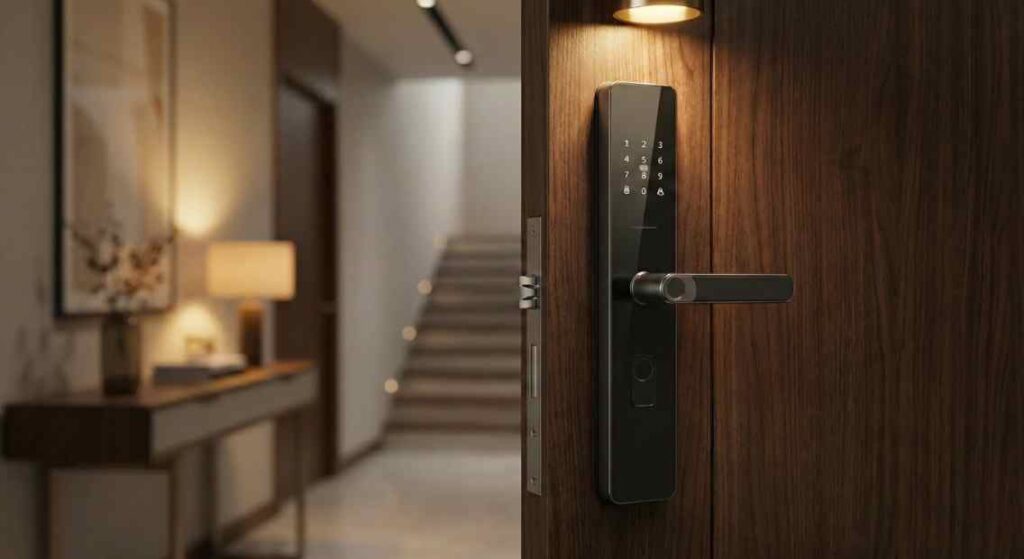
Most people choose a door lock based on what it looks like from the inside. The handle style, the finish, whether it matches the other hardware in the house. These are real considerations.
What gets far less attention is the security performance of the mechanism — which is the thing that actually determines whether the door stays closed when it needs to. A handle that looks right attached to a cylinder that gives way under the wrong kind of pressure is an aesthetically pleasing vulnerability.
When you buy digital door locks or sliding door locks in New Zealand, the sequence should be mechanism first, aesthetics second. Most buyers do it the other way around.
Why Digital Locks Are the Better Starting Point
The strongest argument for digital door locks isn’t technology. It’s key management.
Physical keys are duplicated, lost, and not returned. Rekeying costs money every time the risk profile changes — a cleaner leaves, a flatmate moves out, a spare key can’t be accounted for.
When you buy digital door locks — specifically fingerprint, Bluetooth, passcode, or card access systems like Doric’s DE10 and DE20 — the access management problem disappears. Codes are added and deleted through an app. A cleaner gets time-limited access that expires automatically. A flatmate who moves out loses access without a locksmith visit.
The DE10 and DE20 sit at $399.50 including GST. Both are designed for hinged residential and commercial doors in New Zealand’s aluminium joinery environment. The DE10’s slimmer profile suits doors where depth is constrained. Both support fingerprint, Bluetooth, passcode, and card access simultaneously.
Sliding Door Locks: Where Most Home Security Has a Gap
The ranch slider — the most common large opening in New Zealand homes — is usually the least secured door in the house. The front door gets the deadbolt. The back door gets a decent lock. The ranch slider gets a latch that yields to sustained lateral pressure.
Sliding door locks exist specifically to close this gap. Doric’s Twiin system uses two opposing 6mm hook tongues that engage the frame simultaneously — when force is applied to defeat one tongue, the geometry drives the other deeper. That’s the mechanical consequence of opposing hooks under load, and it produces resistance to lateral force that a single-point mechanism cannot match.
The Twiin uses industry-standard 82mm machining, retrofitting to most existing aluminium sliding door frames without modification. Non-handed — works regardless of which direction the door slides. The DS3621 Avon and DS2210 screen door lock cover other sliding door configurations commonly found in New Zealand homes.
Buying Both — The Whole-Door Approach
The most cost-effective security upgrade for a New Zealand home isn’t buying the best lock for one door. It’s systematically addressing the weakest points across all entry points.
For most properties, that means a digital lock on the front hinged entry and a proper sliding door lock on the ranch slider. When you buy sliding door locks and digital locks together, the system is coherent. The front entry is managed digitally. The sliding door is mechanically secured with a dual-engagement system.
Frequently Asked Questions
Can I install a digital door lock myself in New Zealand?
On a standard residential hinged door with a bored hole configuration, yes. Doric’s DE10 and DE20 are designed for homeowner installation. On aluminium joinery, verify the backset measurement matches the lock before ordering — the two standard measurements are 60mm and 70mm.
How do I know if a sliding door lock will fit my existing door?
Most NZ aluminium sliding doors use 82mm backset machining — which is the standard the Twiin is designed around. Check the existing lock’s machining details or measure the cutout before ordering. Most installations are straightforward retrofits without modification.
What’s the difference between the Twiin and a standard sliding door lock?
A standard sliding door lock uses a single hook tongue engaging the frame at one point. The Twiin uses two opposing 6mm hooks engaging simultaneously. Under lateral force, the opposing geometry means the mechanism gets harder to defeat rather than easier — a fundamentally different security characteristic.
Are digital door locks weatherproof for New Zealand conditions?
The DE10 and DE20 are rated for external door use in New Zealand and Australian conditions — both markets with significant UV, rainfall, and coastal exposure. Standard maintenance (keep the mechanism clean) is all that’s required.
Close the Gap
Most Auckland homes have one strong entry point and at least one weak one. The front door gets attention. The sliding door gets a latch.
Buying digital door locks and sliding door locks as a considered system — rather than as individual purchases — is the approach that actually closes the gap. The mechanism at each entry point is chosen for what that door needs to resist, not for what looks right on the handle.
Doric New Zealand stocks digital door locks, sliding door locks, and a full range of residential and commercial door hardware. Browse and buy at doric.co.nz.